

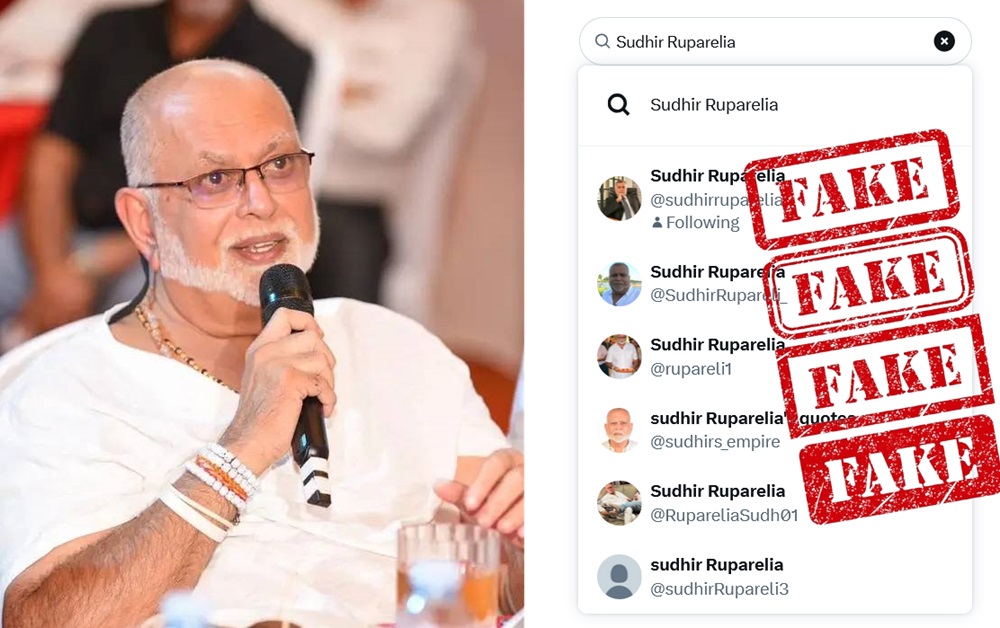
A fresh wave of suspicious social media accounts mimicking Ugandan business magnate Dr. Sudhir Ruparelia has surfaced on X (formerly Twitter), raising concerns over a possible renewed attempt to exploit the billionaire’s public image for fraud.
A search for “Sudhir Ruparelia” on the platform currently reveals several profiles using variations of his name, profile photographs, and identity cues closely associated with the Ruparelia Group chairman — a pattern that cybersecurity observers say is often linked to online impersonation scams.
While one account, @sudhirruparelia, appears to be the authentic and publicly recognized profile, several others have emerged using near-identical spellings and visual branding that could easily mislead unsuspecting users.
Among the accounts appearing in search results are @SudhirRupareli_, @rupareli1, @RupareliaSudh01, and @sudhirRupareli3, as well as @sudhirs_empire, which openly identifies itself as a fan page and states that it is not officially associated with Dr. Ruparelia.
The appearance of these profiles has renewed fears that fraudsters may once again be attempting to ride on Sudhir’s reputation to lure members of the public into deceptive schemes, particularly at a time when social media impersonation and digital investment scams are becoming increasingly sophisticated.
Dr. Sudhir Ruparelia, one of Uganda’s most prominent entrepreneurs, has over the years built a powerful business empire spanning real estate, hospitality, education, finance, and manufacturing. His high public profile and wide business influence make him an attractive target for online impersonators seeking to manufacture trust and legitimacy.
Cybersecurity experts warn that such accounts are commonly used to push fake investment opportunities, solicit money transfers, promote cryptocurrency schemes, or distribute phishing links disguised as lucrative business offers.
What makes such operations dangerous, experts say, is that they often rely on small details that can easily escape casual users — such as a missing letter in a username, a slightly altered spelling, or the unauthorized reuse of a well-known public figure’s profile photo.
In the current batch of suspicious accounts, several of those warning signs are already visible: minor handle variations, low follower numbers, limited posting history, and in most cases, no clear disclaimer indicating that the profiles are unofficial.
The concern comes against the backdrop of a broader surge in digital fraud involving fake celebrity and executive endorsements, particularly across Africa, where fraudsters are increasingly using social media, manipulated branding, and even artificial intelligence to trick victims into parting with money or personal information.
Sudhir himself has previously had to publicly distance himself from fake accounts and false online promotions using his name, underscoring a recurring challenge faced by many high-profile business leaders in the digital age.
Members of the public are now being urged to remain vigilant and to avoid interacting with any account claiming to represent Dr. Ruparelia unless its authenticity has been independently verified.
They are also being advised not to send money, click on suspicious links, or engage in financial discussions through unverified social media profiles, no matter how convincing they may appear.
Anyone who encounters a suspicious account is encouraged to report it directly to X for impersonation review and to cross-check any claims through official Ruparelia Group communication channels or trusted media reports.
The latest emergence of lookalike accounts serves as yet another reminder that in today’s digital landscape, a familiar face online is no longer enough proof of authenticity.