

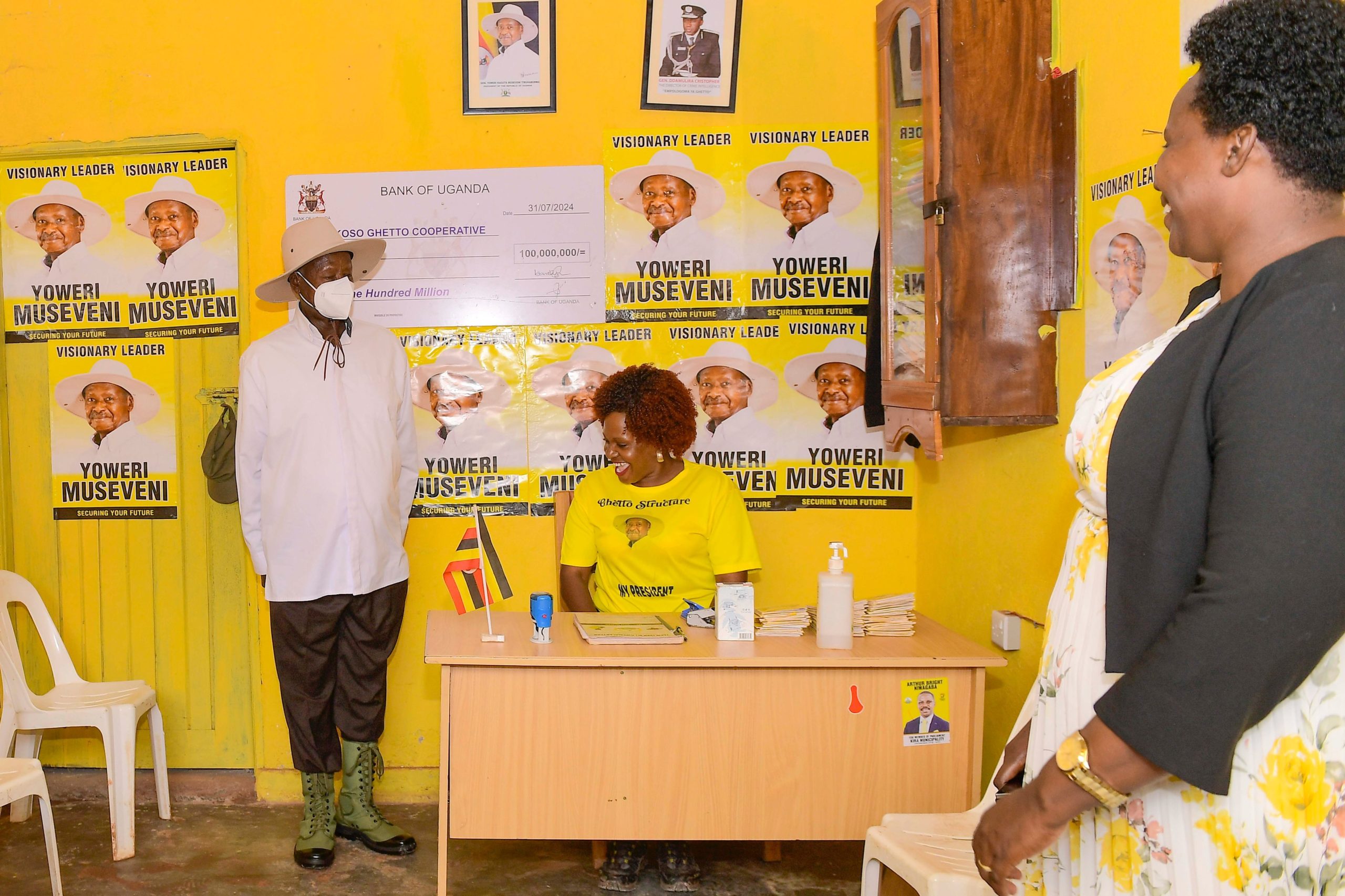
President Yoweri Kaguta Museveni has once again demonstrated his commitment to empowering ghetto youths with an additional shs 1.2 billion to support Savings and Credit Cooperative Organizations (SACCOs) across the Kampala Metropolitan area.
During a visit to Kasokoso Ghetto on Thursday, July 10, the President expressed admiration for the positive transformation witnessed among the ghetto youth, attributing the success to the strategic initiative spearheaded by Maj Gen Christopher Damulira, the Director of Crime Intelligence in the Uganda Police Force.
Damulira, who has been working quietly behind the scenes since 2022, led efforts to identify, rehabilitate, and regroup ghetto youth into organized SACCOs with the aim of reducing crime and empowering vulnerable communities.
The President had initially disbursed shs 1.2 billion to fund the first phase of the program, supporting 12 SACCOs from areas including Rubaga Kakeeka, Kasangati, Nakawa, Makindye, Kawempe, Nansana, Masajja Para, and Mukono Industrial Zone.
Museveni said he was “deeply impressed by the way the youth have utilized the funds,” noting that the SACCOs are not only engaged in income-generating ventures such as salons, carpentry, boda boda operations, and agriculture, but are also contributing to social stability and reduced criminal activity.
In appreciation of the SACCOs’ performance and commitment, the President announced a fresh injection of shs100 million to each of the 12 ghetto SACCOs, totaling another UGX 1.2 billion, effectively doubling the government’s initial support.
This is a testament that Damulira’s initiative is working. The President praised the ghetto youth for “choosing development over disorder” and urging them to remain focused on economic empowerment.
According to internal reports, the SACCOs have attracted over 3,000 registered savers, collected shs 13.7 million in voluntary savings, and demonstrated strong governance structures—all of which have encouraged further government support.
The President emphasized that these SACCOs will now be considered for integration into broader national programs like Emyooga and the Parish Development Model (PDM).
With this renewed funding, the Ghetto SACCO model stands out as a promising tool for fighting urban poverty and crime, driven by community ownership and state backing.