
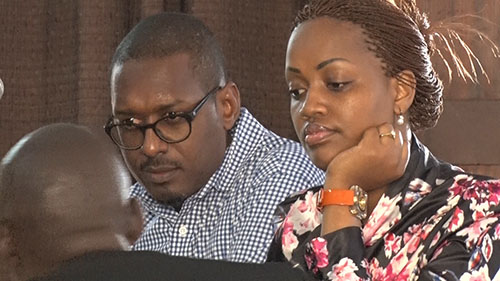
Mathew Kanyamunyu, the businessman convicted over the 2016 killing of child rights activist Kenneth Akena, has for the first time publicly opened up about the incident and its aftermath, issuing a detailed and reflective statement on X (formerly Twitter) on Wednesday morning.
In the statement, Kanyamunyu acknowledged causing “grave harm without intention,” reaffirming that he took responsibility both under Ugandan law and Acholi customary justice.
He noted that he sought reconciliation, made restitution, and served his prison sentence, while stopping short of claiming absolution.
“I do not deny what happened nor do I claim absolution from its consequences,” Kanyamunyu wrote, adding that he lays the burden of his past “at the foot of Christ.”
The statement appears to be a response to renewed public criticism over his re-emergence in public discourse, with Kanyamunyu arguing against what he described as a societal tendency to permanently silence or erase individuals even after accountability has been met.
He framed his experience as emblematic of a deeply polarised society that struggles to forgive unintended crimes, arguing that forgiveness would require acknowledging that “ordinary people can cross irreversible lines without intention.”
In a notable section of the statement, Kanyamunyu expressed profound gratitude to the Acholi people and cultural institutions, particularly Ker Kal Kwaro Acholi, for guiding the reconciliation process through traditional mechanisms including Laro Lok, Tito Tyen Lok, and Culo Kwoo.
These processes culminated in restitution and forgiveness from Akena’s family, years after the fatal shooting.
“I am equally indebted to the family of the deceased, who, despite enduring immeasurable loss and ongoing pain, found the moral strength to pursue reconciliation, accept restitution, and extend forgiveness,” he said.
Kanyamunyu described the Acholi cultural approach as an “oasis of hope” and a model for national healing, arguing that forgiveness does not erase pain but reflects moral strength and humanity.
The 2016 shooting of Kenneth Akena in Kampala sparked national outrage and intense legal proceedings.
Kanyamunyu was initially charged with murder, later pleading guilty to manslaughter in 2020 after entering a plea bargain.
He was sentenced to five years and one month in prison and was released in April 2024 after serving his term with remission.
His statement has already triggered renewed debate online over justice, forgiveness, accountability, and the role of traditional reconciliation mechanisms in Uganda’s justice system.